
What Vineland Resident Lookup Can Verify
No single Vineland record answers every name question. The tax and parcel layer can identify a listed owner, a situs address, a mailing address, and block and lot. A deed can date a transfer. A court jacket can place a party in a case. A voter-status result is limited to the person’s own registration status, and a vital record is a restricted event record rather than an open name list. Probate, historical directories, business filings, and licenses can add dated context, but each has a different meaning. Treat a name search as a comparison of separate records, not as a universal current roster.
| Record | What It Confirms | Where | Access |
|---|---|---|---|
| Tax parcel | Listed owner, situs, mailing address, block and lot | Vineland assessor, NJGIN, city GIS | Office, annual data, or map; protected names may be redacted |
| Recorded deed | Grantor, grantee, legal description, book/page, recording date | Cumberland County Clerk | Current or archive index, record room, or certified copy |
| Court jacket | Party, venue, docket, caption, initiation date | New Jersey Judiciary | Public index; case details and restricted matters vary |
| Voter status | Named person’s registration status and civic geography | New Jersey Voter Information Portal | Individual status lookup with exact-name limits |
| Vital or probate record | Event or estate relationship | Vineland registrar, state office, Archives, Surrogate | Eligibility and record-specific restrictions apply |
Start with the record that fits the question. A listed owner belongs in the assessor and deed trail. An heir question belongs with a death event and probate. An old address is better tested through a dated directory or deed than through a present-day court result. The county clerk’s deed index and the local assessor keep ownership clues separate from an occupant claim.
Vineland Resident Lookup Needs Two Records
Same-name results are common. Normalize the full name first: try a hyphen or space in the surname, a middle initial, a suffix, a maiden or married name, and any known business name. Then require two independent details before treating a Vineland name result as the right person. A matching municipality or ZIP, a spouse or parent name, a parcel, an event date, a court venue, or a public business affiliation can supply the second detail. Do not combine loose clues into a current-address claim.
This is a useful comparison between a name hit and a verified identity. A deed party may have moved after recording, a tax mailing address may belong elsewhere, and a court party may share a name with someone else. Keep the source date beside each clue. The result is a dated evidence trail that can be checked by the actual custodian.
Vineland Court Record Names
The New Jersey Judiciary search menu separates civil and foreclosure cases, criminal cases, criminal judgments, judgment liens, tax cases, municipal information, and records requests. In the civil and special-civil public case jacket, party-name search uses an Individual or Business choice, last name, first name, optional middle initial, county or venue refinement, and date criteria. A CAPTCHA can appear for judgment searches. This is a case index, not a proof that a party now lives in Vineland.
| Search field | Type | Requirement or use |
|---|---|---|
| Individual or Business | Mode choice | Select the party context before a party-name search |
| Last Name | Text | Required in the Judiciary example |
| First Name and MI | Text | First name refines results; middle initial is optional |
| County or Venue | Refinement | Use a Vineland or Cumberland connection to narrow a shared name |
| Date criteria | Refinement | Use when a known case period separates similar results |
| Docket number | Separate search tab | Opens the specific case route when already known |
Use the party-name result to capture the docket number, then retain the venue, caption, and initiation date before asking for a copy. The search result has the key details that distinguish a result from a mere name match:
- Indexed party name and individual or business context
- Venue or county
- Docket number linked to the case jacket
- Case caption and initiation date
- Pagination and any visible result count
See the public case-jacket search before entering a name. The image shows why the party-name and docket-number routes should be kept distinct.
A docket opens the jacket, but sealed, expunged, juvenile, adoption, and other restricted material is not an ordinary public-name result.
The Judiciary’s Find a Case landing page also shows the separate databases available before a Vineland court search begins.
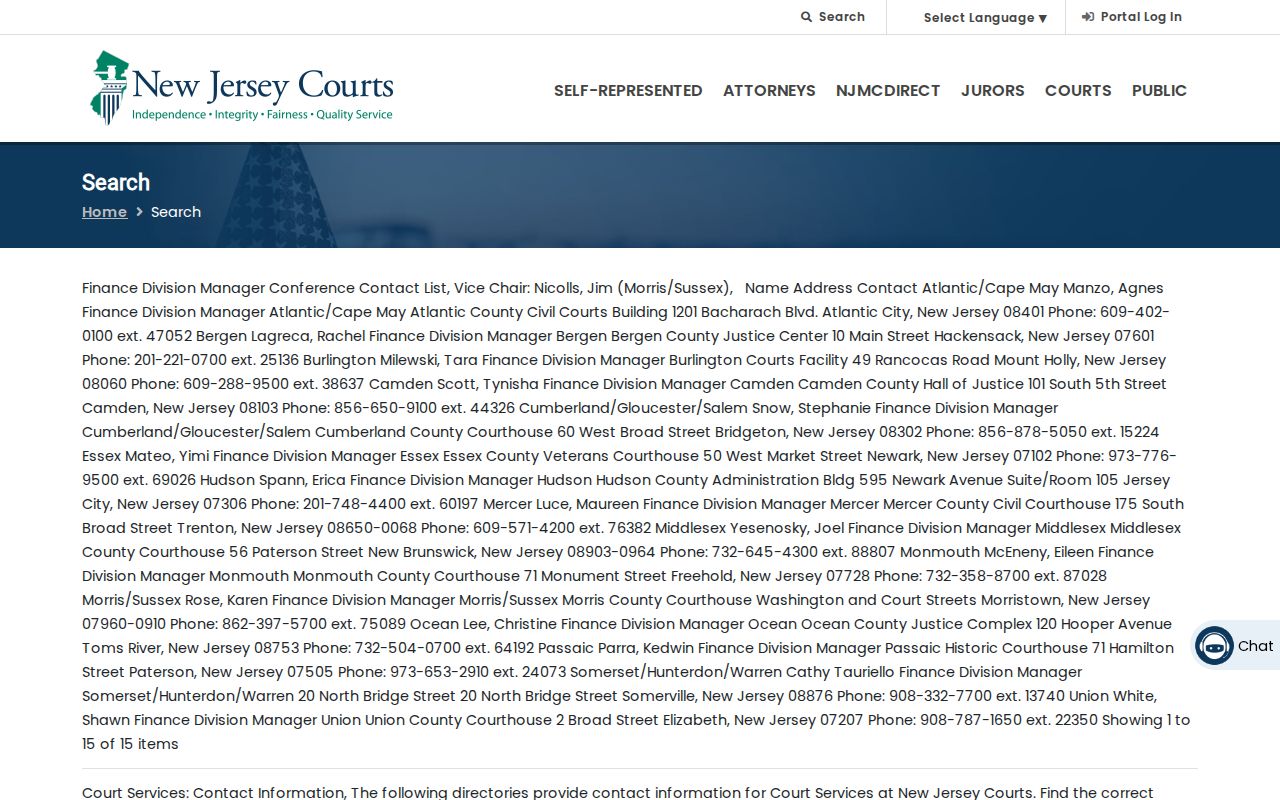
For an open-file copy, use the appropriate case-management office or Vineland Municipal Court; archived files and statewide categories may require the Superior Court Clerk route.
Note: Finalized criminal judgments from June 30, 2017 forward are online, while older judgments go to county Criminal Division records staff.
Vineland Voter Record Names
The official New Jersey voter-status lookup is an individual self-status tool. The entered name must match the spelling supplied by the county. Hyphens, spaces, marriage-name changes, initials, nicknames, symbols, and suffixes can all produce a non-match. A successful result may confirm active or inactive status, registered municipality, district, and polling place for the named person. It does not publish ballot choices or authorize a street roster.
The manual capture below documents the official entry point, whose live field labels and result screen were not available to automated research. Check the spelling, city or county, and birth-date details against the person’s own records before deciding a no-result means anything.
The official registration-check screen is the source shown here.
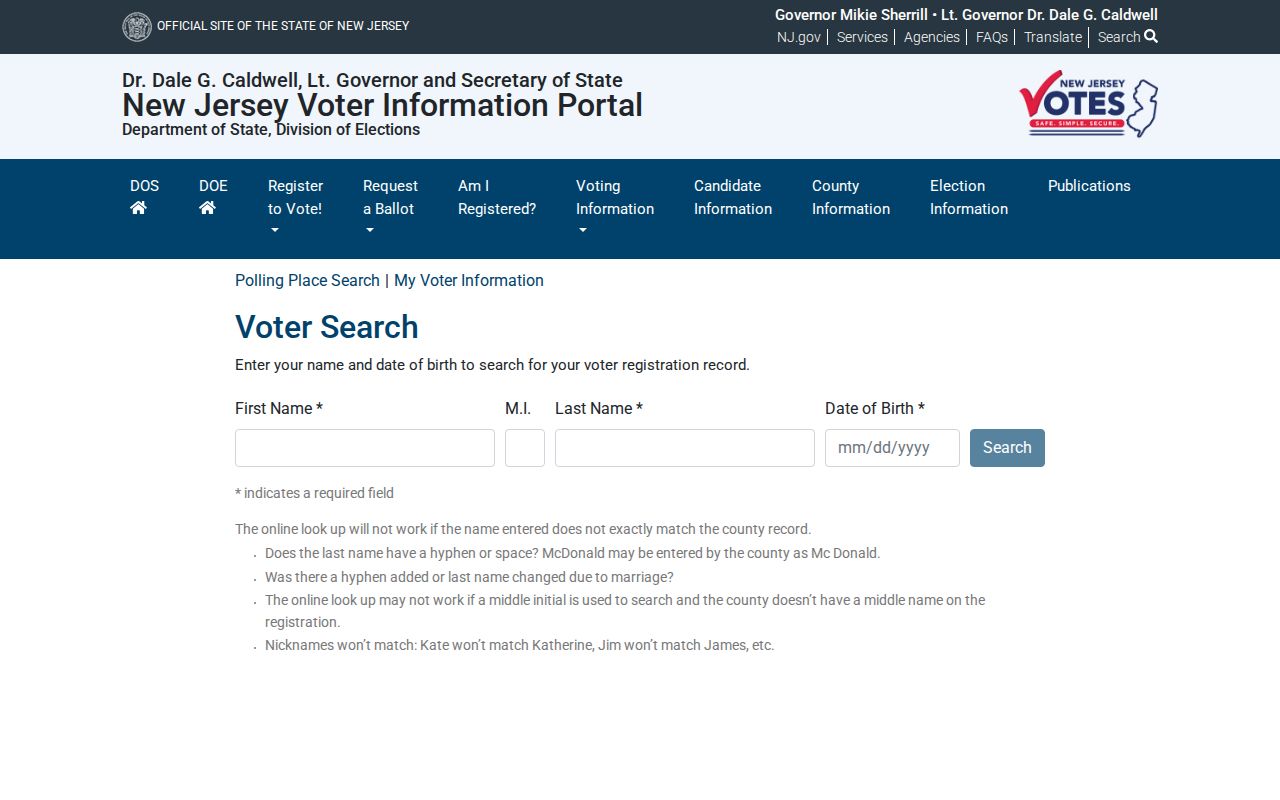
When a status needs correction, use the election office rather than treating an inactive flag or a blank address as a permanent identity finding.
Verifying a Vineland Resident Record
Anchor a likely identity to a dated official record, then test it against a second source. For a listed parcel owner, collect the block and lot, situs address, mailing address if lawfully shown, and latest deed reference. For a case party, keep the docket and venue. For an heir, work from a death record or obituary to the Surrogate. The point is to confirm the meaning of a record, not to make every database answer the same question.
- Write the full name and documented spelling variants, then select the record type that matches the question.
- Capture the address, block and lot, event date, venue, or relationship that ties the result to Vineland.
- Check a second independent source, such as a recorded deed, court jacket, restricted vital route, or probate file.
- Request a custodian copy only when the record is needed, and preserve its date and stated limitation.
- Docket
- A court’s identifying number for a case. It leads to the case record but does not by itself prove a party’s present address.
- Index versus image
- An index lists searchable fields such as a name or date. An image or file copy is the underlying record and may have access limits or fees.
- Certified copy
- A legal copy issued on safety paper with a raised seal. It differs from a plain informational certification.
Vineland Vital Record Cutoffs
Vital certificates are not an open Vineland name database. The Vineland Health Department Vital Statistics and Registry keeps local event certificates, while the New Jersey Office of Vital Statistics and Registry holds current statewide records and the State Archives holds older historical material. Non-genealogical birth records within 80 years, marriages within 50 years, deaths within 40 years, and civil unions or domestic partnerships are restricted. Genealogical access still requires the person named to be deceased and follows the same age cutoffs.
A certification is plain-paper information and cannot establish identity or legal status. A certified copy is a legal document. Certified-copy eligibility is limited to the subject, specified family or legal representatives, government agencies for official purposes, or a court order. The state vital-record guidance sets out the identification, relationship, payment, and submission requirements.
Use the state application guidance as the source for the requirements shown below.
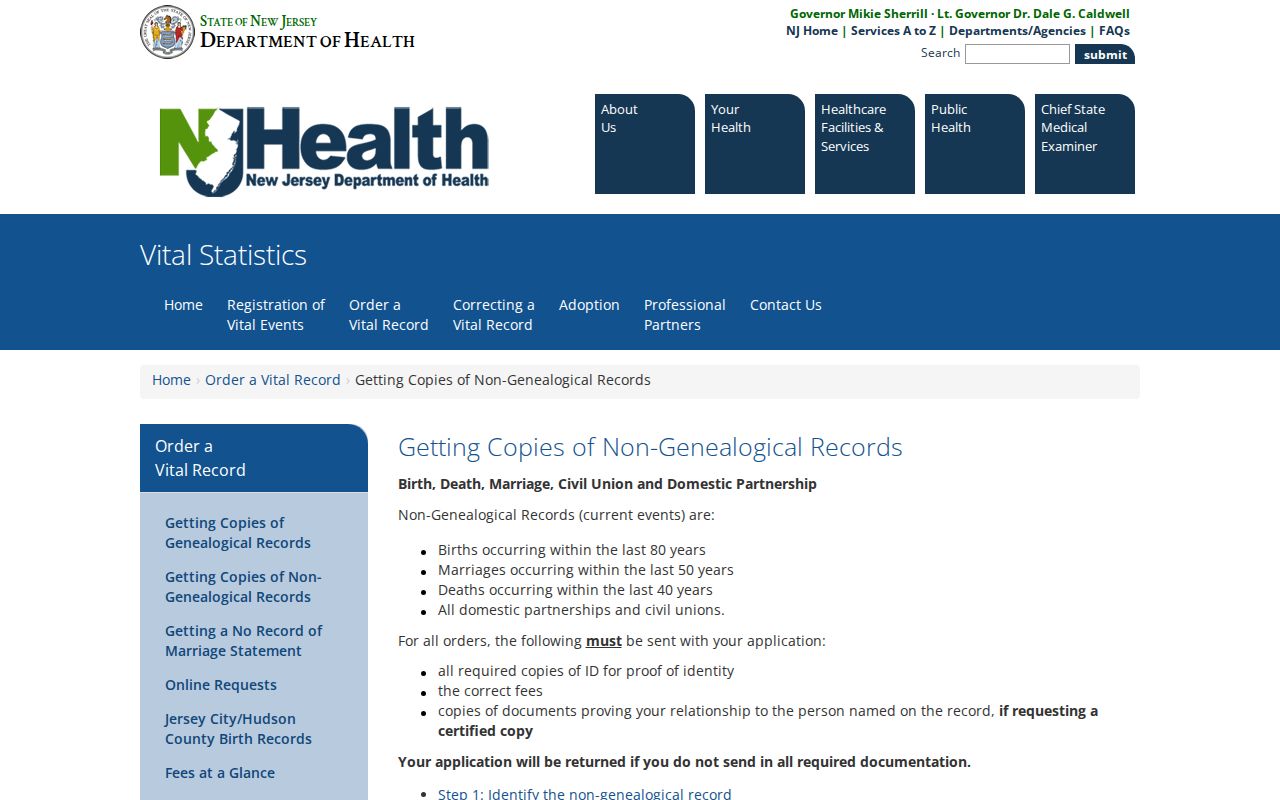
The application route is useful when a documented family event must be confirmed; it is not a substitute for a broad public name search.
For a historic lead, the State Archives holds births through 1924 or 1925 and marriages and deaths through 1950. An older marriage search may also require the county marriage books because returns were filed by officiant name.
Vineland Heir Record Routes
Estate questions can move from a death event to the Cumberland County Surrogate, which handles probate, wills, estates, guardianships, and adoption filings. The new Vineland satellite at 2745 S. Delsea Drive provides the same services by appointment, while the county’s March 2026 announcement says paperwork and applications may be delivered without an appointment. Call first because the two access instructions need to be reconciled for the specific filing.
New Jersey also provides an official, limited route for birth-family contact. The Adoptees Birthright Act and Department of Health New Records System provide an authorized adult-adoptee path to an uncertified original birth certificate, while the CP&P Adoption Registry supports registration, non-identifying background, eligible limited searches, and referral. Sealed original records stay sealed where the law requires it. Neither route is a private investigation service.
For an old person or household trail, a historical entry may provide a dated address before modern records are checked. The verified holdings belong with the Vineland city directories, not with an assumed current identity.
Legal Limits for Vineland Resident Records
New Jersey’s Open Public Records Act, N.J.S.A. 47:1A-1 et seq., requires a request for an identifiable government record rather than a research question. Cumberland County’s ordinary response period is generally seven business days, with fourteen business days for qualifying commercial-purpose or Daniel’s Law review requests. A specific request can be filed online, on paper, by mail, fax, or in person when a record is not indexed. Standard copy fees are $0.05 for a letter page and $0.07 for a legal page unless another law applies.
Address Confidentiality Program participants can use a substitute address. Daniel’s Law protects qualifying judges, prosecutors, law-enforcement personnel, and household members, and NJGIN redacts covered owner names. DMV, utility, delivery, sealed court, and protected vital information are separate privacy boundaries. A blank field should be treated as a custodian limitation or safeguard, never an invitation to reconstruct a hidden address.
Lawful use. Use Vineland records for a personal, lawful purpose. New Jersey stalking and harassment laws apply, and public information must never be used to watch, threaten, harass, or harm another person.