
Vineland City Directory Holdings
Vineland’s historical directory record is a shelf of confirmed runs, not a single uninterrupted series. The earliest local evidence found is a Cumberland County directory that includes Bridgeton, Millville, and Vineland for 1869–70. Later county volumes, Boyd’s editions, and twentieth-century microfilm build a useful sequence. Each item has a different custodian and access path, so the year and holding should be checked before treating it as a local copy or a complete resident list.
| Collection | Years | Where Held | Access |
|---|---|---|---|
| Cumberland County directory covering Vineland | 1869–70; 1871–72; 1874–76 | WorldCat and genealogy-library finding aids | Verify the scan or shelf location before travel |
| Boyd’s Cumberland County directories | 1879–80; 1893–94; 1895–96 | Gloucester County Historical Society reprint record | Finding aid or reproduction, with local availability to confirm |
| Cumberland and Salem, then Cumberland County directories | 1905–06; 1909–10 | Morris Township Library, MF DI 0015a | Microfilm finding-aid access |
| Cumberland County Farm Directory | 1913 | Morris Township Library, MF DI 0110 | Microfilm finding-aid access |
| Vineland city directory | 1921; 1924–25; 1929–30 | Morris Township Library, MF DI 0090 | Microfilm, with some established image-collection leads |
| Later Vineland issues listed in finding aids | 1937; 1957; 1959 | Image and finding-aid listings | Repository must be verified before relying on a copy |
The reliable Vineland-specific spine is 1921, 1924–25, and 1929–30. A secondary aid reports a possible 1959–87 sequence, but no official shelf catalog or publishers for that reported run were located. That limitation matters: an absent name can reflect a missing volume, a scan restriction, or a listing choice rather than a move.
Note: Record the volume year and custodian beside every transcription because nearby directory years are not proof of continuous annual publication.
Vineland Microfilm Calls by Year
The Morris Township Library city-directory finding aid gives a concrete request vocabulary. Ask for MF DI 0090 for the Vineland issues dated 1921, 1924–25, and 1929–30. For the countywide bridge volumes, request MF DI 0015a for 1905–06 and 1909–10, or MF DI 0110 for the 1913 farm directory. A call number is more useful than a broad request for old phone books because it identifies the particular reel before a visit or interlibrary inquiry.
The 1905–06 and 1909–10 reels are countywide. They can connect a Vineland surname to nearby Bridgeton or Millville context, but they should not be read as a Vineland-only roll. The 1913 farm directory is another separate layer. It can help with rural or agricultural households, while its absence says nothing about a family living in the planned center or elsewhere in the county.
Use the Vineland Public Library catalog with separate searches for “Vineland directory,” “Cumberland County directory,” “reverse directory,” “criss-cross,” “telephone directory,” and “Polk.” Its visible controls include a search term, search-type selector, scope selector, Submit, and Advanced Search. Different wording matters because catalog subjects need not be full-text descriptions of each volume.
Vineland City Directory Research Desks
Vineland Public Library’s research resources provide a local starting point for catalog work, digitized newspaper selections, and database access. The library is at 1058 E. Landis Avenue, and its main published phone is (856) 794-4244. Its microfilm room closes before the building, and published hours vary between pages, so call ahead when the plan depends on a reel or newspaper. Research help is listed at extension 4243, while remote databases generally require a Vineland Library card.
The library research-resources screen shows the card-based research access and the notice relevant to a Vineland city directory search.
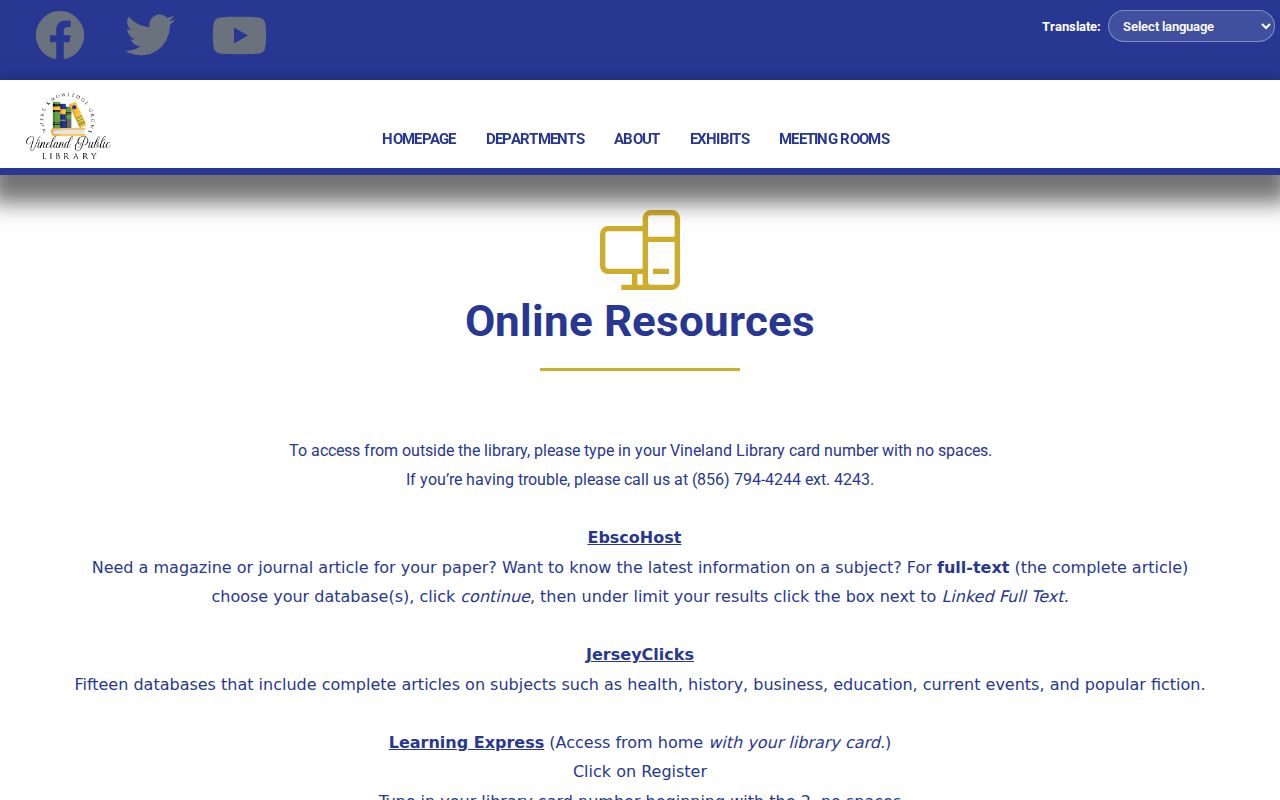
The catalog and reference channel can establish whether a requested directory is print, microfilm, an interlibrary-loan candidate, or unavailable locally before a researcher assumes a run is on the shelf.
The Warren & Reba Lummis Genealogical & Historical Research Library in Greenwich is another documented route. It holds genealogy material, rare books, deeds, and maps. Published research hours are Wednesday and Saturday from 10 to 4 and Sunday from 1 to 4, with appointments; its published phone is (856) 455-8580. The custody differs from Vineland Library, so a request should name the person, street, approximate year, and item type.
Reading a Vineland City Directory Listing
A directly inspected, unambiguous Vineland directory entry image was not available in the research set. That gap means no particular abbreviation or printed mark should be claimed for every Vineland issue. Once a verified scan or microfilm page is open, create an entry inventory from what the page actually prints. Preserve the page number and repository with the transcription, then distinguish a direct statement from a later conclusion about the household.
| Entry element | What to preserve |
|---|---|
| Volume and page | Record the directory year, exact page, and image repository or reel before extracting a name. |
| Printed name | Copy surname, given name, initials, suffix, and spelling exactly as printed. |
| Address form | Keep the house number, direction, street type, and any older jurisdiction wording. |
| Household notation | Record spouse, relationship, widow, boarder, or similar notation only when the entry shows it. |
| Occupation or business text | Transcribe the stated wording without converting it into a present-day identity claim. |
| Ownership or occupancy mark | Use a mark only after checking the volume’s own abbreviation key; it is not verified as universal across Vineland runs. |
- Criss-cross directory
- A street-order section that groups entries by address instead of alphabetically by person.
- Householder index
- An alphabetical list focused on household heads or addressable entries, which may leave out other people.
- Abbreviation key
- The volume’s explanation of its shorthand. Photograph or note it before interpreting a letter beside a name.
A reverse-address section is valuable for house history, but it is still a publisher’s dated snapshot. The current parcel route belongs with the Vineland Streets directory when the task shifts from a historic listing to modern address-keyed records.
Vineland City Directories Beside Sanborn Maps
A directory can suggest who or what was connected to an address. A Sanborn map can help test whether the place itself existed in the same form. The Library of Congress 1891 Vineland Sanborn item has six public-domain sheets. The Vineland Historical and Antiquarian Society also links local Sanborn years for 1886, 1895, 1900, 1906, 1912, and 1919. These sheets show street names, building footprints, uses, materials, house or block numbers, hydrants, and utility context. They locate a structure, not its residents.
Vineland Historical and Antiquarian Society resources gather the genealogy request, digitized books, atlas references, postal-history material, and the local Sanborn links.

Pairing a historical-society map lead with a directory year helps separate a changed building, an altered street segment, and a name match that needs another record.
For a careful comparison, write down the directory’s exact address first. Then review the nearest map year, including the street spelling and the surrounding structures. A mismatch may come from renumbering, a former name, a different jurisdiction, or a real change to the site. It should not be corrected by guesswork.
Vineland Directory Years Across 1952
Vineland’s current municipal identity began on July 1, 1952, after Vineland Borough and Landis Township merged following a February 5 referendum. A directory before that change may name either former jurisdiction even when the modern address lies inside Vineland. Search both jurisdiction names and retain the printed form in the research note. This is a records-geography issue, not a reason to silently modernize an older entry.
- 1869–70: Cumberland County material provides the first located directory evidence that includes Vineland.
- 1879–80 and 1893–96: Boyd’s county volumes add later nineteenth-century checkpoints.
- 1905–06, 1909–10, and 1913: County and farm reels provide a bridge into the Vineland-specific microfilm period.
- 1921, 1924–25, and 1929–30: MF DI 0090 supplies the firm city-specific microfilm sequence.
- 1952 and later listings: Check the jurisdiction label, then verify reported 1937, 1957, and 1959 items through a custodian.
This comparison of directory years and city geography is especially important when a surname appears to vanish. A different municipal label can divide one family trail into two catalog searches. No verified last printed Vineland directory year was located, so later gaps should remain labeled as gaps.
Note: A city directory reflects its publisher’s collection date, while a census is an enumeration snapshot with a different timing and purpose.
Comparing Vineland City Directories and Census
Use each available directory as a dated waypoint, then pair it with the nearest federal census rather than treating both as interchangeable. Federal census images are public through 1950 under the 72-year release rule described in the research. A census can add a household snapshot; the directory can place a printed name and address between census decades. Neither source proves that every person lived there for the entire year.
- Find the surname in an alphabetical Vineland or county directory and copy the exact printed name, address, and any household notation.
- Check the street or reverse section when the inspected volume provides one, and document the result separately from the alphabetical entry.
- Repeat at the nearest verified directory years rather than filling absent years with an assumption of annual publication.
- Compare the closest census release, keeping its enumeration date separate from the directory year.
- Test a changed street name, direction, number, or pre-1952 jurisdiction with maps and the 1966 numbering history before combining entries.
A disappearance can mean a move, death, nonlisting, a changed name, or a missing volume. The Vineland Public Library, VHAS genealogy help, obituaries, cemetery custodians, and later official records provide ways to test those possibilities. An obituary is a reported secondary source and should be paired with a contemporary newspaper, vital, probate, or cemetery record when the conclusion matters.
Vineland City Directory Gaps and Local Names
When a directory omits a person, turn to sources that answer a different question. VHAS offers a genealogy request and digitized historical materials. Vineland Historical Magazine is cataloged from 1916 into the early 1980s with an index and can connect a surname or address to a biography, local event, or organization. It is not a substitute city directory, but it can provide a lead worth checking against the dated volume.
The Vineland Daily Journal has digitized selections through the library, while regional microfilm context for the Daily Republican/Daily Journal reaches from 1923 to the present. Newspaper notices and obituaries may add relatives, former addresses, or cemetery references. Cemetery lists at Lummis are still being expanded, so a missing hit is not definitive. Ask the custodian whether the relevant list is complete and whether a newer transcription exists.